A mash-up of three children’s book classics tells Alice, Wendy, and Dorothy’s story if one were to become a psychiatrist, another a cowgirl, and another a detective. McElrath’s imagination is on fire.

When she was seven years old, young Alice Liddell went gathering mushrooms in the woods. After finding several beneath an ancient oak, she popped one into her mouth.
An hour later, a large, anthropomorphic rabbit came along, wearing a waistcoat and carrying a pocket watch, complaining about being late for some appointment. Alice later remembered following it down a dark hole…
Thus, Alice began learning early on about the psychoactive effects of particular plants and fungi. Now, 40 years later, psychiatrist Dr. Alice Liddell-Dodgson takes on two nine-year old patients who have had remarkably similar experiences. One is the daughter of a London investment banker. The other is being raised by her aunt and uncle on a wheat farm in rural Kansas.
Wendy Moira Angela Darling and Dorothy Gale are as different as two young girls can be, but they – as well as Dr. Liddell-Dodgson – have all experienced what she terms as ‘delusional psychosis.’ After a year of ‘Doctor Alice’s’ treatment and counseling, Wendy and Dorothy have accepted that their experiences in ‘Neverland’ and the ‘Kingdom of Oz’ were nothing more than visions, the product of extreme physical and emotional trauma – little different from Dr. Liddell-Dodgson’s own girlhood delusions of ‘Wonderland.’
But were they delusions?
What are the odd slippers Dorothy was found wearing the morning after a cyclone? Where did they come from and why does she refuse to take them off? And why does Wendy’s mother speak so strangely about old Celtic folk legends? What do they have to do with a buccaneer ancestor and a Lost Cause of two centuries ago?
Even Dr. Alice, a woman who has dedicated her life to science, finds herself confronting disturbing reminders of a manic-depressive haberdasher and a dangerously psychopathic monarch with a fetish for decapitation . . .

K.J. McElrath started writing professionally for search engine optimization firms in 2006, and thus has written about everything from insurance and litigation to diet pills and lingerie. His first published work of contemporary fiction was Tamanous Cooley, a modern-day take on Dante’s The Inferno with a Native American twist.
Mr. McElrath is also a composer of numerous works for orchestra and winds as well as incidental music for theater and the score for a stage musical, The Adventures of Dex Dixon, by Pacific Northwest playwright and screenwriter Steve Coker. He is known for his witty song lyrics in the style of masters such as Ira Gershwin, Al Dubin, Johnny Mercer, et. al. Several sets of Mr. McElrath’s song lyrics appear in The Loves of Natalie Greenbaum, an LGBT romance series set during the Big Band Era and the Second World War.
Avis: Welcome to a new edition of Your Next Favorite Author! I’d like you to meet Kevin, K.J. McElrath, a friend of mine since graduate school, and a multi-talented musician, singer, performer, and author! He’s gifted, and I’m happy to introduce his latest work today, Three Lost Girls, the surprising story of three girls from the pages of our favorite children’s classics!
Shall we begin? Here’s our first question.
Have you ever gotten reader’s block?
Kevin: Only when the plot doesn’t hold my interest, or I don’t care about the characters.
Avis: Sounds like you move on to the next novel like I do! So, you probably haven’t had reader’s block! Our next question is about names:
Did you ever consider writing under a pseudonym?
Kevin: I’ve actually done that. I still self-publish some graphic novellas and comics under a pseudonym.
Avis: Cool! You really are talented! Now I want to know the pseudonym! How about this question?
Do you think someone could be a writer if they don’t feel emotions strongly?
Kevin: Depends. Most fiction, no – but non-fiction topics such as history, politics and society and science, I think detachment would be very helpful.
Avis: Good point! Non-fiction allows one to remain detached to a certain extent. Great answer! Here’s the next question.
What other authors are you friends with, and how do they help you become a better writer?
Kevin: There’s my former spouse, Athena – she reads or listens to my material and always has helpful feedback. She is also a merciless editor. There is also a gentleman in Florida who writes under the name Staten Rall, with whom I share an interest in 19th-Century U.S. history.
Avis: Finding a merciless editor is a gift! Having other writers in our lives improves out own writing by leaps and bounds. Our next question always interests me.
Do you want each book to stand on its own, or are you trying to
build a body of work with connections between each book?
Kevin: I tend to favor book series. It gives me more opportunities to explore the characters, how they grow and change over time and respond to historical events and trends. Even when I do different series with different characters, most of my stories take place in the same ‘universe,’ and occasionally, these characters meet and interact briefly.
Avis: I can see that playing out in Three Lost girls. The historical facts you include really peak the reader’s interest. Ready for our last question?
If you could tell your younger writing-self anything, what would
it be?
Kevin: Stick to writing what you know. Don’t try to tell a love story when your 17. Life experience is necessary in order to write a convincing narrative. Also, if you’re setting your story in a different time period and/or place, be prepared to do a whale of a lot of research. Even if you change historical events and geographic locations (as Mark Twain did), it’s good to ‘know the rules’ so you can break them convincingly.
Avis: LOL! What great advice! These are words of wisdom that every writer could ascribe to!
It’s been great getting to know more about you as a writer and published author, and I look forward to seeing the next installment of this series! Yes readers, there are two more books that follow Alice, Wendy, and Dorothy on more adventures through the early to mid-20th century!
For more information about K.J. McElrath see his social links below and check out my review of Three Lost Girls below!
Kevin’s Social Links!
https://www.facebook.com/groups/891979061341607
https://www.instagram.com/kjmcelrathauthor/
https://kjmcelrath.com
https://3lostgirls.com
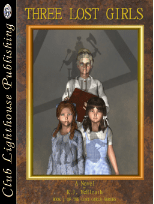
Amazon: Three Lost Girls
The Review of Three Lost Girls, by Avis M. Adams
KJ McElrath is releasing another novel, and this one is a mash-up of Through the Looking Glass, The Wizard of Oz, and Peter Pan. McElrath uses his prodigious knowledge of history and historical events to infuse this mash-up with influences of the early 20th century to the 1930 and 40s, and it works.
McElrath fans will revel in identifying the “Easter Eggs” he plants as the story unfolds. There is always a subtext to twist what our heroes know and understand, and there is always an exploration of economy, class, and gender roles and identity as the story progresses, so even though this could be considered a historical novel and retelling of these classics, it is also very current in its discussions.
New readers to McElrath might get lost in the long windup in chapters one and three, but hang with the story because once McElrath pitches the ball, the game is on, and this book becomes a fast paced and very enjoyable read.
So let me back up a bit. Have you’ve ever wondered what happened to Alice to make her follow that white rabbit, or if Wendy’s flight with the fairies and Pan captured your imagination? Have you wondered how Wendy or Dorothy fared after their return from Neverland or Oz? Did you ever wonder how they resolved what happened to them?
McElrath grapples with those questions and more and brings in a much older Alice as the guide and therapist to counsel Wendy and Dorothy. We meet psychiatrist Dr. Alice Liddell Dodgson in her practice at The Liddell-Dodgson Asylum for Juveniles in 1905. Wendy is her patient and Dorothy’s case has come to her attention. Dr. Liddell-Dodgson is well poised to help the girls deal with all of their issues, and the good doctor, as a trained scientist, will use her experiences and knowledge to bring both girls back from the trauma of their fantastic experiences, Alice begins in 1905 shortly after the inception of the talking cure in 1895, and continues her work with the girls into the 1940s.
The book moves between three points of view, Alice, Wendy, and Dorothy, and we see the experiences and the retelling of these favorite children’s tales retold through the eyes of Alice, a scientist, and Wendy and Dorothy as prepubescent children. By the end of the book, two young women have come to terms with their supernatural experiences in an interesting and unexpected way.
To say that this book is entertaining is an understatement. Readers won’t be able to put the book down, and the wonderful references to each of these time-honored tales raises the reading pleasure. I highly recommend this novel but be prepared to wade through the first several chapters. I promise, it’s worth the wait! This is a well-crafted and highly entertaining book, and I give it four stars.
 Avis M. Adams